A major discovery in the Sahara Desert left archaeologists struggling to understand what they had uncovered.
Initially, researchers did not have a clear idea of what they had found. Portions of the fossilized remains were unusual enough that the research team was unsure how to analyze them.
This new discovery posed a fascinating question.
What type of huge predator roamed the ancient Sahara?
Initial discoveries at a remote Sahara site
The Sahara Desert was not always as large and dry as it appears today.
Millions of years ago, several regions across the area contained rivers, lakes, and ecosystems capable of supporting huge predators.
By studying fossils from these ancient environments, scientists can develop a better understanding of the distant past.
A team of researchers recently recovered unusual fossilized remains in a remote fossil site in Niger.
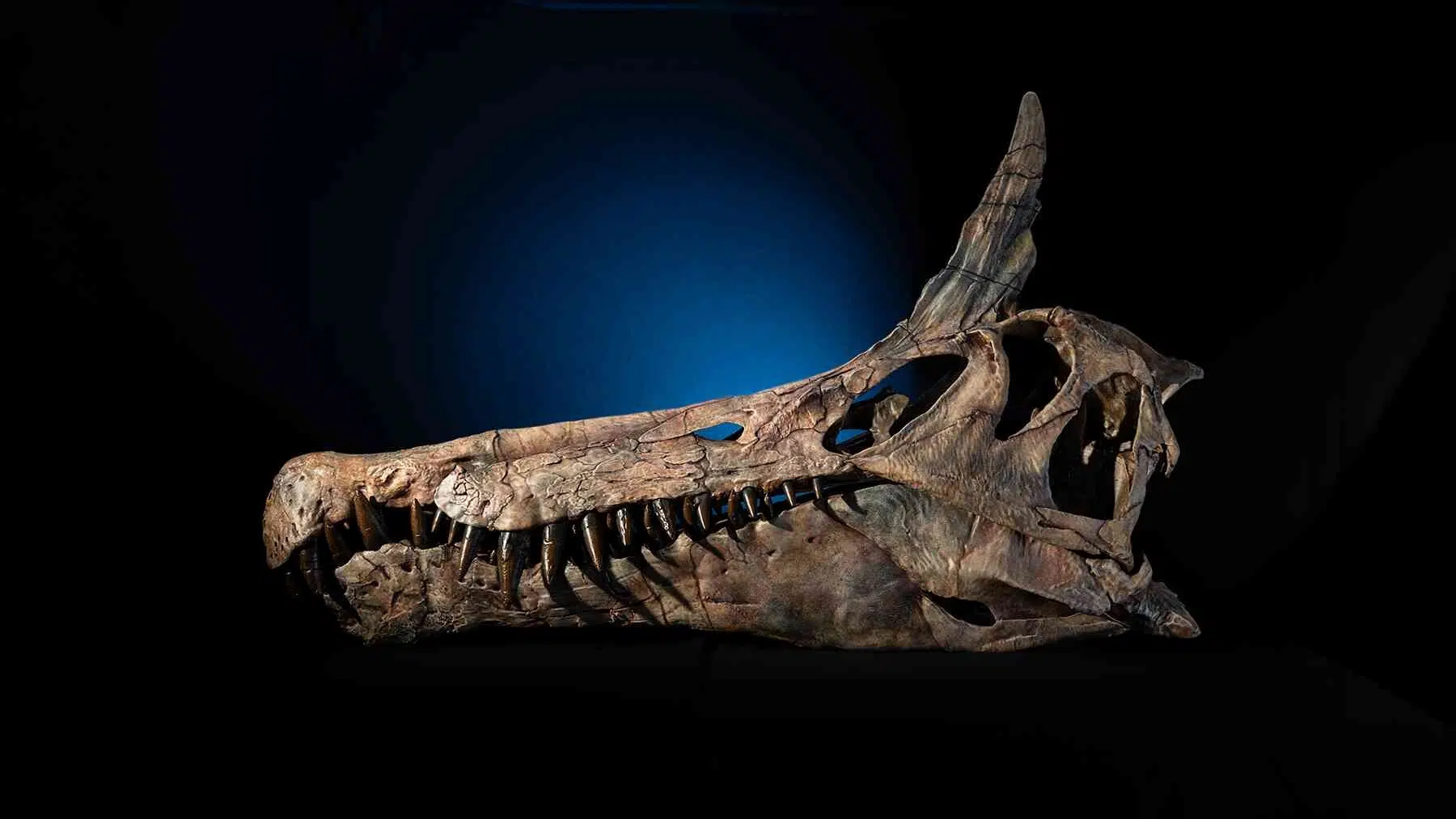
The team recovered skull fragments as well as portions of a unique head crest.
These fossil remains were significant because they differed from previously known dinosaurs.
At first, researchers did not understand the crest’s importance. Only after returning to the site and collecting more samples did they realize they had uncovered something completely new.
Challenging established theories on ancient habitats
The discovery presented a greater context than simply identifying another dinosaur.
Spinosaur fossils were previously mostly limited to coastal regions, leading many researchers to question why this pattern existed.
They thought these animals likely spent most of their time living in or very close to marine environments.
The newly recovered remains were from an interior part of the land, nearly 400 miles away from the closest shoreline of their time period. This indicated that at least some of these creatures lived hundreds of miles from coastal waters.
Further analysis of this discovery challenged previous notions regarding where these predators lived and hunted.
Researchers at the University of Chicago now strongly hypothesize that some members of this ancient group likely inhabited vast inland river systems throughout the continents.
Uncovering the identity of the desert predator
The discovery answered the question as to what the 40-foot predator was. It was a member of a new species named Spinosaurus mirabilis.
According to scientists, it was the first unequivocal addition to this group in over a century.
One of its greatest distinguishing characteristics was a sharp, curved crest atop its skull resembling a scimitar.
Specialized traits of the newly found species
Scientists observed that the crest was like nothing they had seen before in the Spinosaurus group.
Based on available fossil evidence, they believed it was covered in keratin and probably exhibited vibrant colors.
Spinosaurus mirabilis roamed Earth approximately 95 million years ago and was clearly designed for catching fish.
Its teeth were arranged uniquely, forming a fishnet effect for capturing slippery prey. Such an adaptation made the animal a highly successful predator in ancient waterways.
What was initially considered an enigmatic set of fossils led to an extraordinary discovery.
It became one of the most remarkable paleontological finds in recent memory.
A new species was added to the family tree of dinosaurs. Researchers also gained a better understanding of how such gargantuan predators lived in the ancient Sahara.
The discovery further challenged assumptions regarding where members of this group could thrive and how they adapted to different environments.
The findings continue to reshape scientists’ understanding of ancient ecosystems.
Long after decades of exploration, finds in remote deserts continue to expand our knowledge of ancient life.
If you want to learn more about this discovery, you can check the full study here Paul C. Sereno et al., Scimitar-crested Spinosaurus species from the Sahara caps stepwise spinosaurid radiation. Science 391, eadx5486 (2026). DOI: 10.1126/science.adx5486
Read the whole thing?
Get the week's signal, not the noise
Our sharpest reporting on energy, climate and nature — free, once a week.