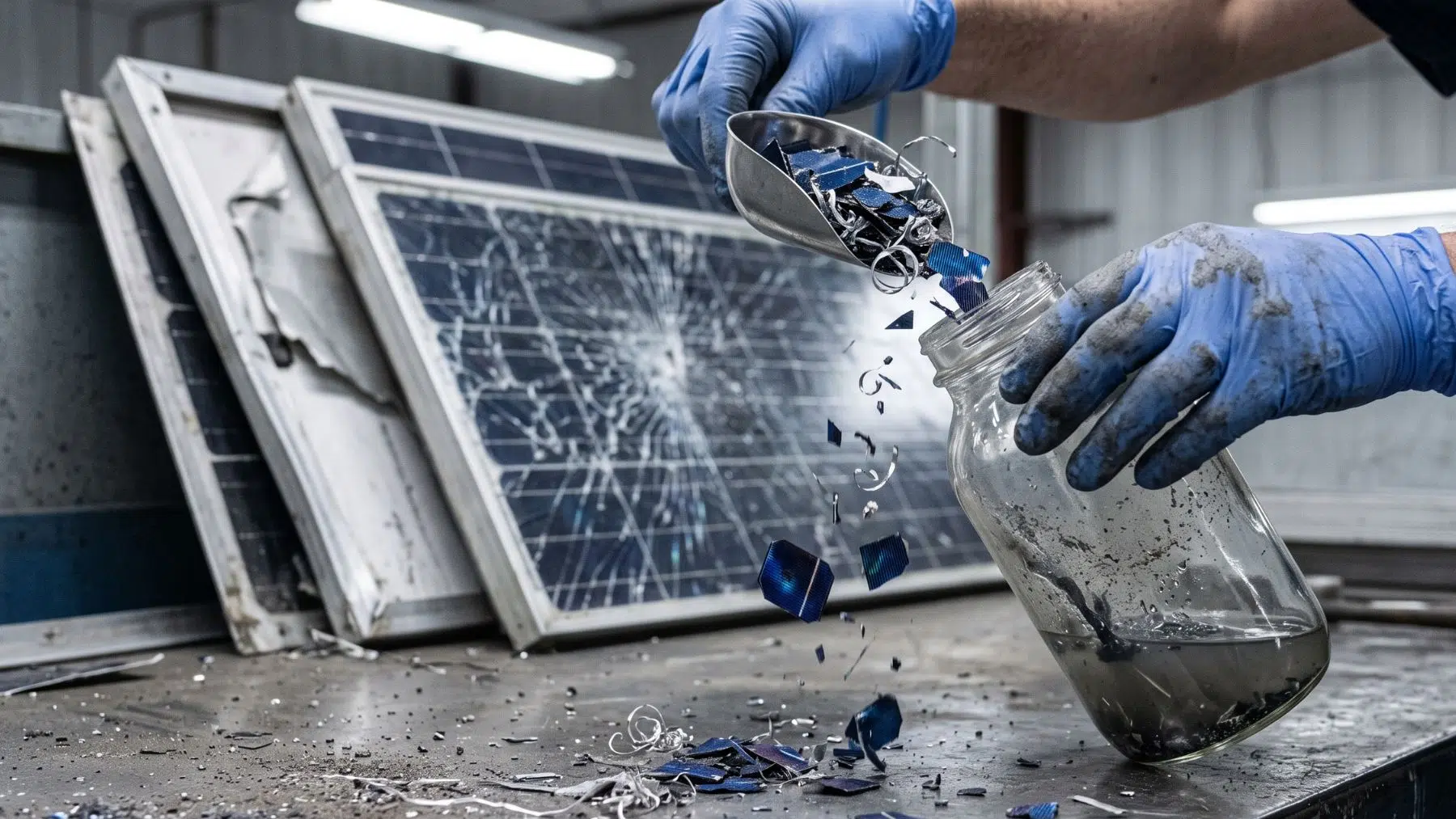
Before a retired solar panel can be called anything official, somebody breaks it into pieces smaller than a fingernail.
The pieces go into a sealed bottle of weak acid, and a rack turns that bottle end over end for 18 hours.
Then the liquid is drained and measured.
More than 5 parts per million of lead and the panel is hazardous waste. Less than that and it is not.
Two panels off the same line in the same year can land on opposite sides.
What is in the sandwich
A crystalline silicon panel is glass, a polymer encapsulant, cells, an aluminum frame and a junction box. The metals worth arguing about are silver, copper and lead, and the lead sits mostly in the solder ribbon joining one cell to the next.
It has been there since the first commercial modules. Solder has to survive twenty five years of thermal cycling on a roof without cracking, and nothing about that choice was ever hidden.
What gets reported wrong is the cadmium.
Silicon panels do not contain any. Cadmium belongs to thin film modules built on cadmium telluride, a separate technology holding a small slice of a market that is over 95 percent crystalline silicon, so a sentence listing cadmium inside a rooftop panel is describing something that does not exist.
Why one model goes both ways
The regulator’s own wording here is unusually blunt. Some panels are hazardous waste and some are not, even within the same model from the same manufacturer.
That is not sloppiness. Cell layout, ribbon thickness, solder alloy and the glass to metal ratio in a given batch all move the result, and the procedure measures what comes out in the liquid rather than what went in at the factory.
So a pallet of identical looking modules has no single answer attached to it. Whoever owns them either pays to test a sample or assumes the worse case.
For a crew pulling an array off a roof on a Thursday, that question rarely surfaces at all.
What a real landfill does
A one year experiment put four commercial panel types into different liquids and left them there. Three synthetic solutions at different acidities, and alongside them, actual leachate drawn from a municipal landfill.
In the mildest synthetic solution the silicon panels gave up the most, with silver reaching several hundred parts per million and lead reaching roughly twenty three. Those are large numbers, and they come from crushed fragments sitting in clean water.
In the real landfill leachate the release was close to minimal across every type tested.
The most any sample surrendered under the harshest condition was about thirty percent of what it started with. The authors’ conclusion was that short tests on tiny fragments do not represent how a whole panel sits in a dump, which cuts against the alarming reading and against the reassuring one at the same time.
The rule that keeps moving
There is a fix on the table and it is not complicated. Moving panels into the universal waste category would let owners hand them to a recycler without the full hazardous waste paperwork.
The agency announced that rulemaking in the autumn of 2023. The start slipped from the middle of 2025 into early 2026, with completion aimed at the summer of 2027.
Two states went ahead without waiting. California and Hawaii classify panels as universal waste, around 35 states have some decommissioning or waste policy on the books, and fewer than ten run an actual recycling program.
So the question sits with whoever is holding the pallet, which is the usual shape of anything the grid pushes outward, from a solar highway surface to a fox settling under a mounting rack. The agency page spells out the test and what it means for owners.
Where the panels are actually going
Two towns in Georgia are doing the work and they get mixed up constantly. Cedartown has a recycling plant that started up in early 2026 and recovers about 96 percent of the material value in a module, scaling toward five gigawatts a year.
Cartersville, an hour east, runs a separate operation owned by a panel manufacturer, sized at roughly 250 megawatts annually. Different company, different town, different scale.
The awkward part is the glass, which is most of the weight. Solar glass carries antimony at around 2,000 parts per million, and that keeps the shards out of ordinary flat glass production, which is the readiest recovery route there would otherwise be.
One state passed a producer funded takeback law and then spent years rewriting it, with stewardship plans due from manufacturers in 2030. The panels are coming down either way, as state programs have been pointing out for a while.
The only open question is whether they go to Cedartown or into a hole with no test at all.
Read the whole thing?
Get the week's signal, not the noise
Our sharpest reporting on energy, climate and nature — free, once a week.