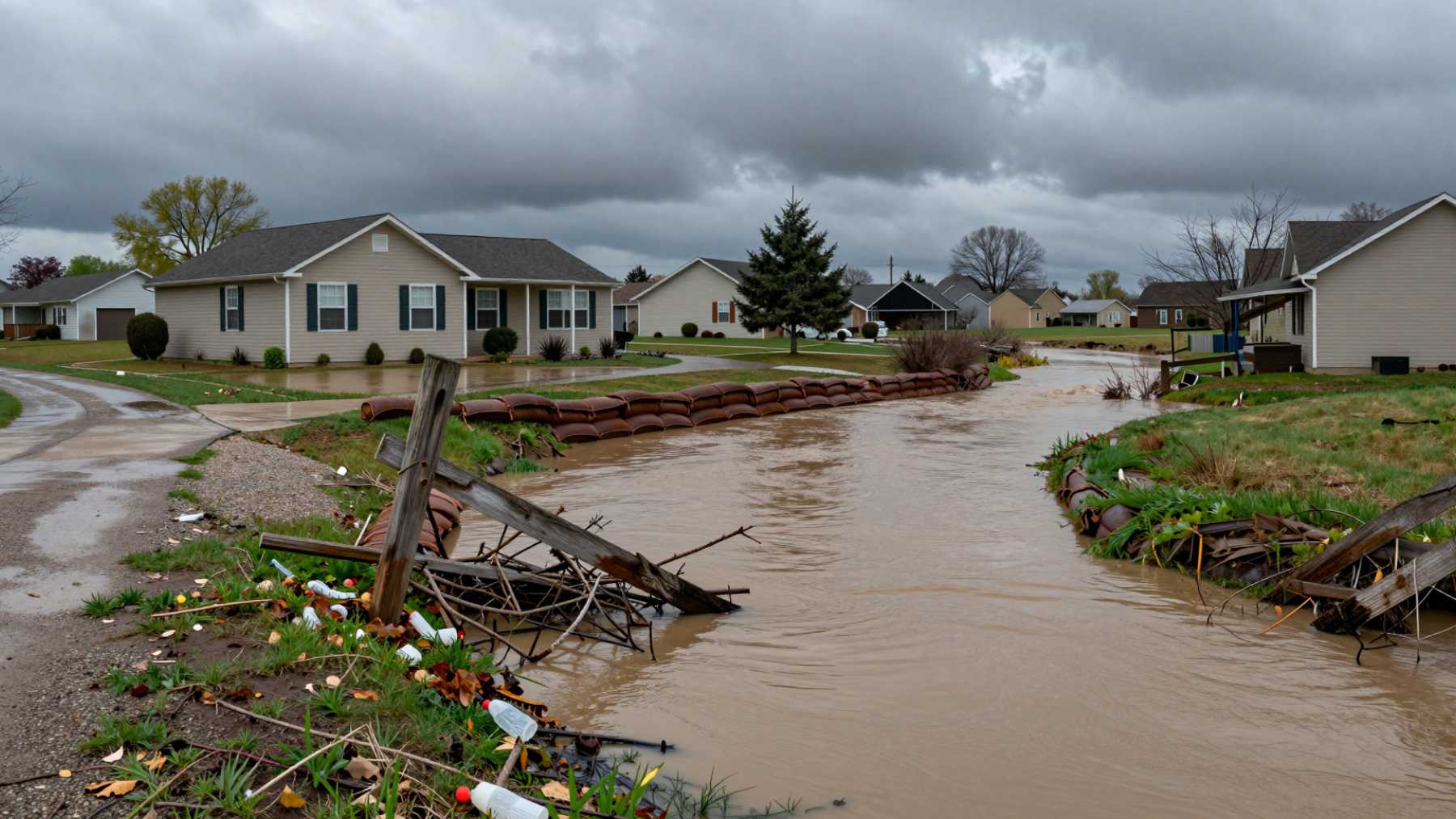
When Americans picture catastrophic flooding, they picture the big rivers — the Mississippi swelling past its banks, the Ohio swallowing riverside towns, the Missouri pushing levees to their limits. But a new study suggests the greater danger by 2050 may lie somewhere far less dramatic: the smaller waterways threading through backyards and farmland across states like Ohio and Missouri.
Millions of people live beside these creeks and minor rivers without giving them much thought. A new large-scale analysis suggests they may have reason to start.
The Counterintuitive Finding at the Heart of the Research
The study, published in Nature Sustainability, set out to answer a question most flood models have sidestepped: does flood risk scale with river size? Researchers integrated high-resolution hydrodynamic simulations, demographic projections, and current flood defense data across the contiguous United States. What they found flips the conventional assumption.
Smaller rivers show greater sensitivity to climate change-driven increases in flood intensity by 2050 than larger ones. That alone would be notable. The study adds a second layer: flood defenses along small rivers are currently the weakest of any river-size category in the country.
Put those two findings together and you get a compounding problem — higher hazard, lower protection, and growing populations nearby. The result, the researchers suggest, is that communities beside small rivers face disproportionately higher flood risk than their neighbors along the major waterways that dominate public attention and infrastructure budgets.
Why Small Rivers Respond Differently to a Warming Climate
The physics here matter. Small watersheds are more reactive to intense, short-duration rainfall — exactly the kind of event that climate change is making more frequent. A sudden downpour that a large river absorbs as a modest rise can overwhelm a small river in hours.
Large rivers have real buffering capacity. Their basins collect water from vast areas, smoothing out precipitation spikes across time and distance. Small rivers don’t have that luxury — when a heavy storm hits a compact watershed, the water has nowhere to go but downstream, fast.
The study found that flood risk along small rivers is primarily driven by increasing climate-related hazard severity combined with low defense levels. That’s a distinct dynamic from what’s happening along larger rivers, where rising exposure — more people moving into floodplains — is the dominant risk driver rather than the hazard itself intensifying. That distinction matters enormously for how policymakers should respond.
A Defense Gap Measured in Billions
The infrastructure gap is stark. Historically, flood defense investment in the US has prioritized large rivers, and that made a certain practical sense: big rivers flooded big cities, and the economic case for levees and flood walls was easy to make. Small rivers got less attention, and the gap has only widened.
The study puts numbers to the cost of catching up. Restoring future flood risk along small rivers to historical baseline levels would require the highest flood defense investments of any river-size category — up to approximately $4 million per kilometer (in 2005 USD). That figure reflects not just the scale of infrastructure needed, but also how far behind these waterways already are.
The researchers describe this as a critical mismatch: the places where flood defense needs are growing fastest are precisely where existing defenses are thinnest. Closing that gap won’t be cheap, and the longer it goes unaddressed, the more expensive the eventual response becomes.
Who Lives in the Risk Zone
Flood risk isn’t distributed evenly, and the study’s demographic projections make that inequity visible. Communities along small rivers tend to be less affluent than those beside major waterways, with fewer financial resources to adapt independently — whether that means elevating homes, purchasing flood insurance, or relocating altogether.
Socioeconomic development is projected to increase the number of people living near small rivers between now and 2050, compounding future exposure. More residents moving into these areas means more people in harm’s way, even before accounting for the intensifying hazard itself.
This is where the flood story becomes a story about fairness. The populations bearing the greatest projected increase in risk are often those least equipped to absorb it — smaller, less-protected waterways run through many of the country’s more vulnerable communities, places where a single major flood event can set families back for years.
What Needs to Change Before 2050
The researchers are direct about what their findings demand. Flood defense investment needs to be urgently reprioritized toward small-river communities. Current policy frameworks and funding mechanisms were built around a large-river-centric understanding of flood risk — one this study suggests is badly outdated.
Flood risk modeling and adaptation planning need to catch up too. Keeping assessments focused on big rivers while smaller ones go underexamined leaves the communities most at risk invisible in the policy conversation.
The authors also stress timing. Acting now is significantly less costly than responding repeatedly to flood disasters in communities with no meaningful defenses, and every year of delayed investment narrows the window for cost-effective action before 2050.
The clock is already moving. As climate projections sharpen and demographic shifts continue, the question isn’t whether small rivers will pose a greater threat — the research suggests they will. The question is whether the infrastructure, the funding, and the political will can be redirected in time to meet it. That’s what the next decade will test.
The complete study offers a more detailed review: Jiang, R., Lu, H., Chen, D. et al. Future flood risk concentration for residents near small rivers across the USA. Nat Sustain (2026). https://doi.org/10.1038/s41893-026-01896-7
Read the whole thing?
Get the week's signal, not the noise
Our sharpest reporting on energy, climate and nature — free, once a week.