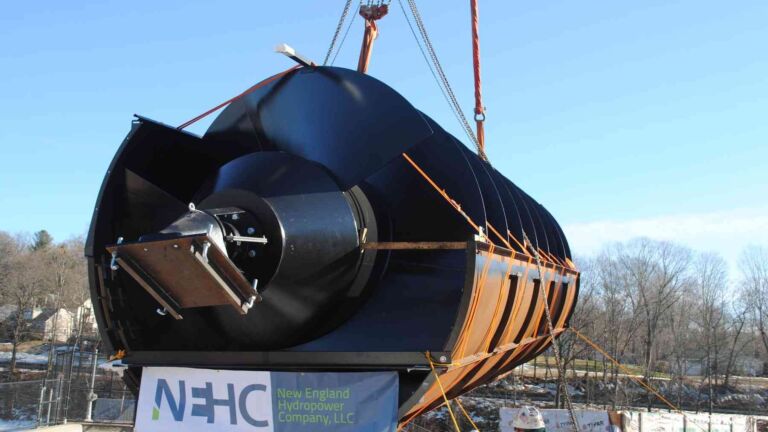
A scrapyard will buy almost anything that came off a wind turbine.
Steel tower, cast iron hub, copper windings, aluminum housings, all of it has a price per ton and a truck that wants it.
Then somebody points at the blades.
They are the smallest part of the machine by weight and the only part nobody bids on, and they sit in the yard long after the rest has gone.
The reason is not the size. It is what they are made of.
Why one part of a turbine refuses to come apart
Everything else on a turbine is one material doing one job. Steel is steel, and a furnace knows what to do with it, which is why 80 to 94 percent of the machine by weight goes straight back into the supply chain.
A blade is three materials fused into one object.
Glass fiber cloth for strength, a light wood or foam core for thickness, and epoxy poured through both to lock them together.
That resin is a thermoset, meaning the molecules cross link into one continuous network during curing, so unlike the plastic in a milk bottle it cannot be melted down and poured into something else.
Heat does not soften it. Heat chars it, and what is left is short fiber and ash.
Which is the cruel part. The blade survives twenty years of hail, ice and constant bending precisely because those three materials will not separate, and that is the property leaving a scrapyard with no move.
What a retired blade actually is
Size is the first shock. A blade off a turbine put up in the early part of this century runs 150 to 200 feet, longer than the wingspan of most airliners, and it was cured as a single shell.
It cannot be shipped in pieces because it was never in pieces.
So the first thing that happens to a retired blade is a diamond saw. Cut into thirds it becomes three sections, each still longer than a school bus, and only then will it fit on a road without a police escort.
Every cut costs money before anybody recovers a dollar of material, which is why the economics start underwater and so many yards simply stack and wait.
Where the numbers come from
The figure everyone quotes comes from two researchers at a British university who modeled installed capacity against turbine lifespan.
Their answer was 43 million metric tons of cumulative blade waste worldwide by 2050, close to 47 million tons in American measure.
The split matters as much as the total. China carries 40 percent of it, Europe 25 percent, the United States 19 percent and everywhere else the remaining 16, so this lands hardest where the building happened first and fastest.
Against that, the blade is a small share of any single machine. Industry figures put it at less than 8 percent of turbine mass, which is why the problem stayed invisible for two decades while the towers went up.
It stops being invisible when the first generation comes down at once.
The routes that are actually running
Cement kilns do the heavy lifting, and it is less elegant than it sounds.
The shredded blade goes into the kiln, the resin burns in place of coal and the glass fiber minerals end up inside the clinker, so one American operator has run over 7,000 turbine blades through cement plants since the start of the decade, each standing in for roughly 5 tons of coal.
The other route keeps the shape instead of the material. A footbridge outside Cork rests on two retired blades, and the engineering estimate put it around 17 percent lower in emissions across a sixty year life than the steel span it replaced.
That works because a blade is already a hollow beam built to hold its own form in a gale, so a section of one arrives pre engineered to a standard no footbridge has ever needed.
The fix that starts at the other end
Every route above is cleanup. The interesting work is happening on the blades not yet built, where the point is to never create the problem, and resins that can be chemically unzipped after curing already exist, which would let the glass fiber come back out intact rather than as dust.
And one German workshop skipped the chemistry entirely by milling wooden blades from laminated veneer lumber, cut on numerically controlled machines with no mold, and the first ones are turning near Kassel.
None of that helps the blades already down. Those were built to a specification that had no end of life written into it, and they will be handled by kilns, saws and improvisation for the next twenty years whatever comes next.
Which is the honest shape of it. A machine that makes clean power for two decades leaves one component that outlives its usefulness, and the industry is counting the pile while it works out what to do.
Read the whole thing?
Get the week's signal, not the noise
Our sharpest reporting on energy, climate and nature — free, once a week.