The truck came round the bend and then it stopped coming round the bend.
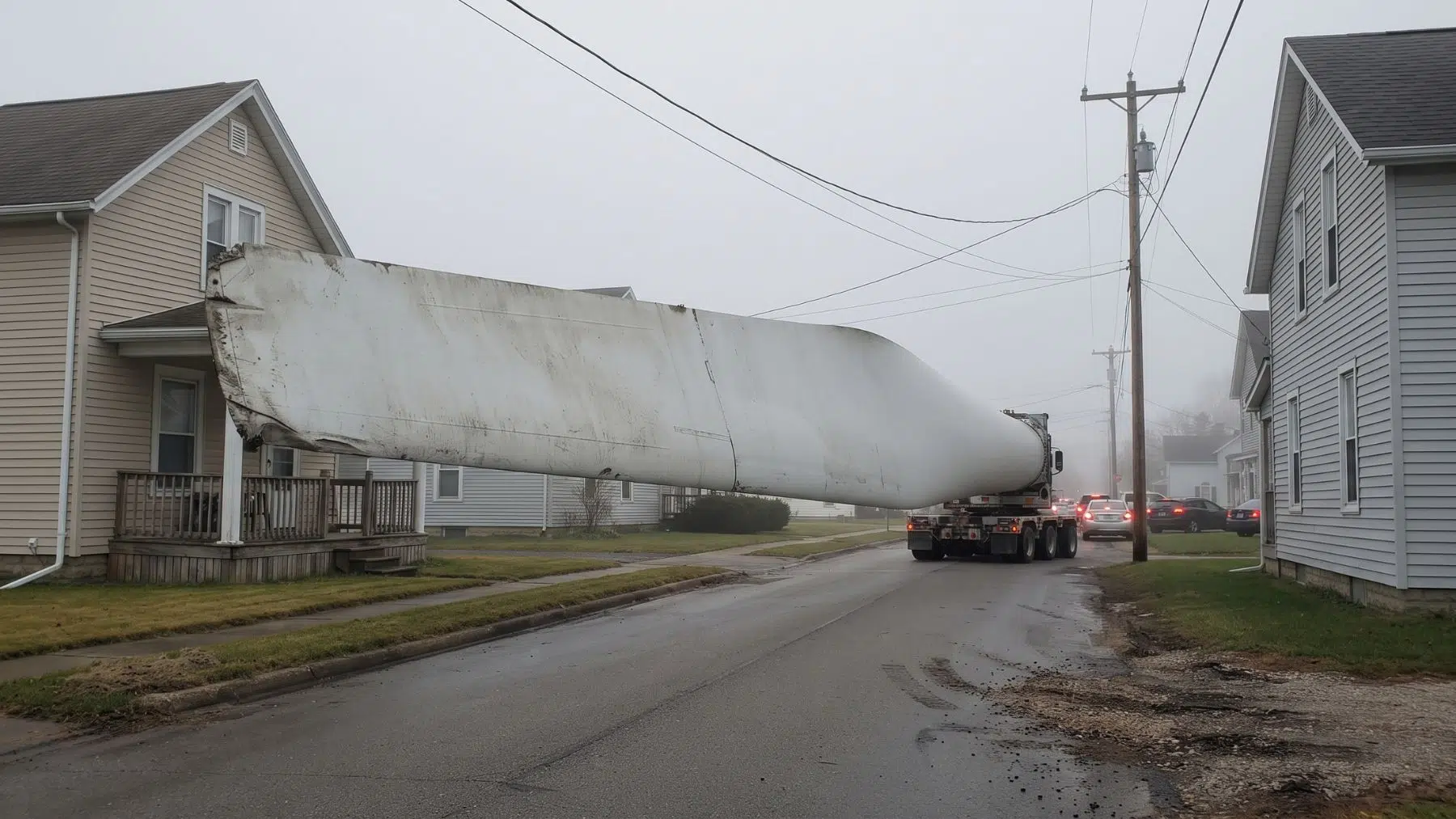
What was behind it kept going, swinging wide across two front yards.
A porch rail was suddenly the nearest thing to a very large white wing.
It came to rest with inches on either side, and the whole street stopped.
Every part of that trip had been approved in advance.
How a load gets onto a street it cannot fit
Oversize hauling in the state runs through an automated permit system. An applicant enters the dimensions and the cargo, the software returns a legal route, and the driver is required to follow it, which is what this driver did.
The application was filed by a permitting service on behalf of the hauler, which is ordinary practice.
What it entered under contents was paper machine roll. The stated length was right, at 159 feet 4 inches, so the system was not blind to the size. But a paper roll and a turbine blade behave nothing alike on a corner. One is a dense cylinder sitting over the axles, the other a long tapering wing whose tip sweeps far outside the path the trailer takes.
The state later added that the actual load was larger than reported. So the route was legal and impossible at once, and nothing in the process was built to notice.
Inches from each house
The bend is on Route 982 near High Street, and it is close to a right angle. The truck committed, the tip swung, and the blade came to rest spanning the gap between two private homes.
The township fire chief was among the first there. “I come up, and there’s” the beam, there’s that wind turbine sitting on that corner to that corner, inches from going into each house, he said.
The houses were spared. A business was not, and that is the part most retellings leave out.
The blade went through the exterior wall of a towing and repair shop on that corner, punching roughly a foot inside, which the owner confirmed afterward. Traffic was rerouted for at least two hours while nobody worked out how to reverse any of it.
Where the numbers come from
The load measured 159 feet 4 inches from the front of the truck to the rear of the blade, and under 10 feet wide.
It set out from the Ebensburg area with about 700 miles of route ahead and a wind farm in Iowa at the end. It got as far as Westmoreland County, a tenth of the way.
The paperwork chain is worth following. The hauler sits in Cedar Rapids, the permitting service that filed for it in Cincinnati, and the route came out of a system in Harrisburg, so nobody in that chain had seen the bend at High Street.
Getting free took longer than getting stuck. The driver reversed nearly a mile to the township municipal building to turn around, and the remote controlled motor driving the rear steering axle failed twice while he did it.
Why blades are bad passengers
A modern blade cannot be shipped in pieces. It is cured as one shell, so the whole thing travels as a single rigid object through turns and under bridges laid out for nothing of the kind.
The trailers built for this are cleverer than they look. The rear axle steers independently, so the back end walks sideways through a curve while the tractor takes the normal line.
It still has limits. A near right angle in a residential street with houses on both sides is the geometry that beats it, and the machinery that would have helped is the machinery that broke, much as an overheight load finds the one clearance nobody measured.
The pressure grows. Blades get longer with each turbine generation, and the build has moved east into dense road networks rather than the open western grid, which puts more of these objects through more small towns every year, as the local coverage laid out.
What the corner got out of it
The useful outcome is narrow and real. The state put a temporary restriction on that stretch of Route 982, so nothing over 100 feet moves through without extra review, and a traffic study will decide whether it becomes permanent.
One bend, one rule, born of a load described accurately in its dimensions and inaccurately in its nature.
That is the honest lesson rather than the dramatic one. An automated system is only as good as the description typed into it, and a form that treats a wing and a cylinder as one shipment keeps producing routes that work on paper, the way a solar highway asks a road for a job it was never laid out for. The follow up reporting tracks what changed.
Nobody was hurt, and the blade eventually left on Route 22 and then Route 66. It is turning somewhere in Iowa by now, entirely indifferent to the wall it went through and to the two front yards it briefly occupied.
Read the whole thing?
Get the week's signal, not the noise
Our sharpest reporting on energy, climate and nature — free, once a week.