
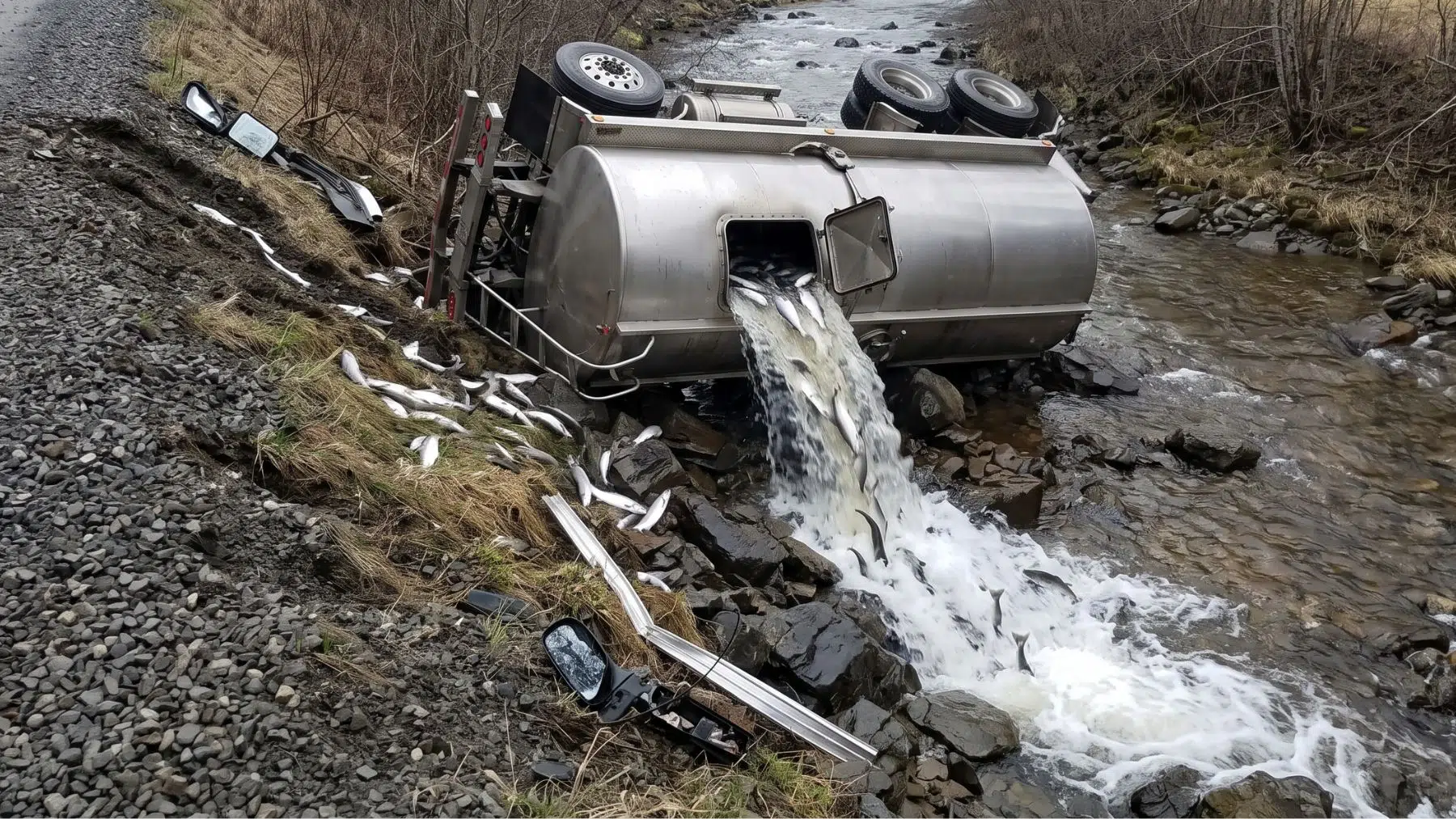
A tanker came around a corner outside Elgin, Oregon, at about half past ten in the morning.
Dew still on the road, a sharp bend ahead.
It went over.
Eighty thousand pounds rolled onto its side, skidded across the pavement and dropped down a rocky embankment onto its roof, and the tank came open.
Water poured out.
So did 102,000 young salmon.
Where 77,000 of them ended up
Below the embankment runs Lookingglass Creek. The wreck came to rest close enough that the water leaving the tank ran straight down the rocks and into it, carrying most of the load with it. Roughly 77,000 fish reached the creek alive.
They did not hesitate.
“The silver lining for me is 77,000 did make it into the creek and did not perish,” said Andrew Gibbs, who coordinates hatchery work in eastern Oregon for the state. “They hit the water running.” The count that did not survive was recorded to the individual fish, at 25,529, because a hatchery load leaves the building already counted.
The driver walked away with minor injuries only.
Why the corner is the whole story
Move the crash a few hundred feet in either direction and this is a different article. Along most of that road the ground beside the pavement is gravel and dry grass, and a tank opening there empties onto rock.
Fish out of water have minutes, not hours.
What made the difference was the slope and the distance to running water, because the tank tore open on the one stretch where the road sits directly above the creek and the ground falls away toward it. Everything that followed was gravity and luck, not planning.
There is also the matter of timing. These were spring chinook at the smolt stage, the few weeks when a young salmon is physically ready to leave fresh water and go downstream. Any earlier and the creek would have been the wrong place for them, and a few weeks later they would already have been released a hundred miles east.
Why fish ride in trucks at all
The load had come out of Lookingglass Hatchery, a few miles from where it rolled, and was booked for the Imnaha River about three hours east. That drive is the ordinary business of salmon recovery in the interior Northwest.
Dams broke the old arrangement.
Rivers that once carried fish to the sea and back now carry them through a series of concrete steps, so hatcheries raise the young and tanker trucks deliver them to the drainage where managers want adults returning in four years. It is a supply chain with a fish in it, and the fish is the part that cannot wait.
A 53 foot tanker is the standard tool. Chilled, aerated, watched the whole way, and hauling a cargo that cannot be set down and picked up again.
What a wrong creek actually means
The fish are not lost. Lookingglass Creek feeds the Grande Ronde, which feeds the Snake, which feeds the Columbia, and from the crash site to salt water is roughly 650 miles of current.
They are simply in the wrong drainage.
A salmon returns to the water it left, so any of these that survive the ocean will come home to Lookingglass rather than the Imnaha. That is a permanent redirection rather than a detour, and it is why managers care which truck goes to which river.
The state expects the loss to show up as 500 to 900 fewer adults returning in the two years that follow, which is the real cost written in fish rather than in dollars. Animals keep ending up where our infrastructure puts them rather than where anyone intended, as a displaced fox found.
What the survivors face is the same gauntlet as every other smolt, only starting from a different door. The state account is careful not to call any of it good news.
The part nobody engineered
It is worth being plain about what this was. A truck crashed, a quarter of a valuable load was lost, and a driver was hurt. Nobody in Oregon is calling it a happy accident.
The odd part is what the other three quarters did.
Given an opening and a slope, 77,000 animals that had spent their whole lives in concrete raceways went down a rock face into a strange creek and immediately started behaving like salmon. No acclimation, no release plan, no hose. Just water going downhill and a fish that knew what to do with it, in the same way a wild pattern turns up without being taught.
That is the thing worth keeping. We build hatcheries, tanks, chillers and schedules around a creature whose entire design is finding moving water, and on one morning outside Elgin the schedule fell over and the design held. A fuller account follows what happens next.
Read the whole thing?
Get the week's signal, not the noise
Our sharpest reporting on energy, climate and nature — free, once a week.


