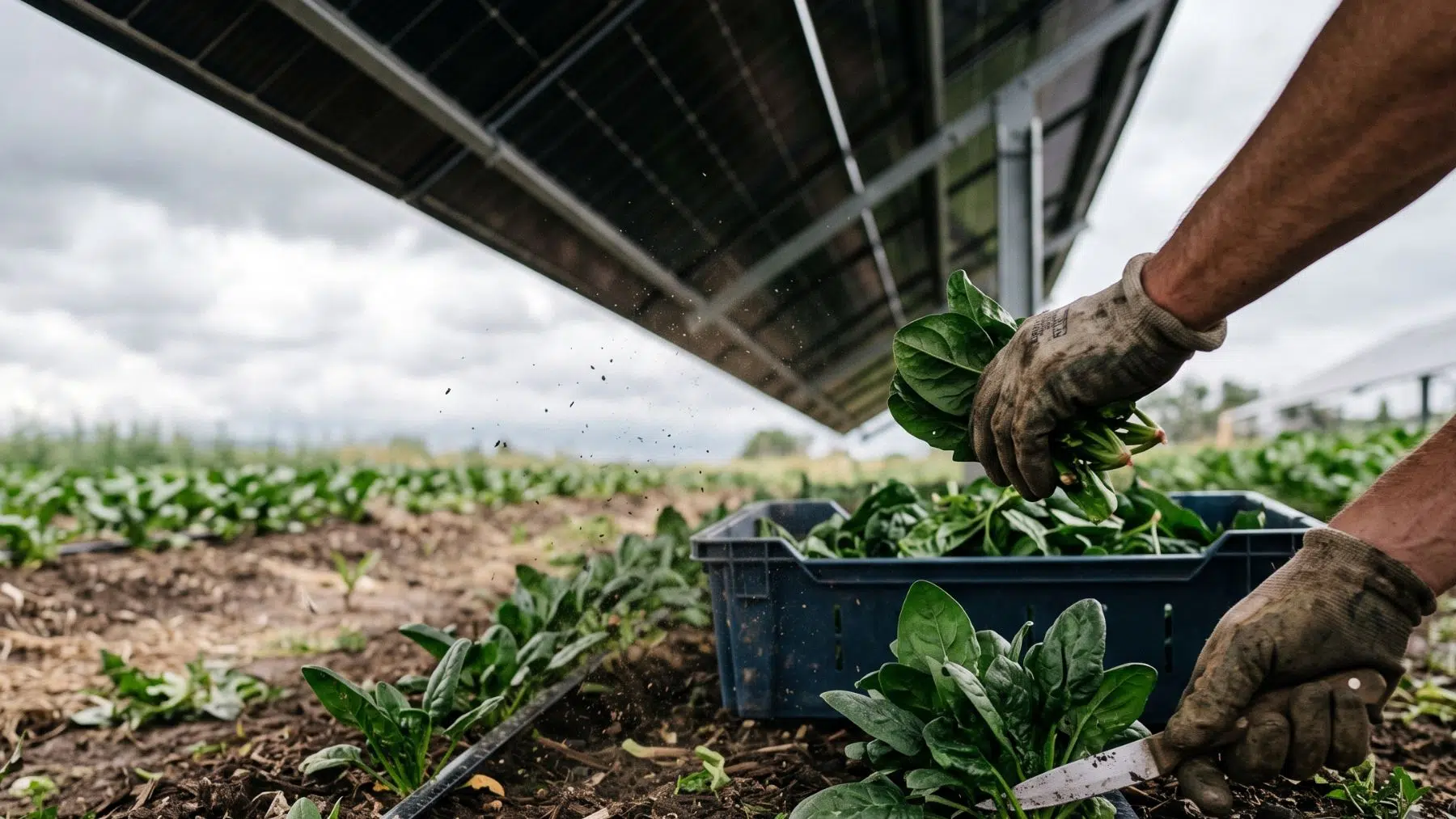
The row of spinach runs flat and dark green between two lines of steel posts.
Above it, a panel the size of a door tilts slowly to follow the light.
Someone kneels in the row and cuts leaves into a crate.
It is August in Colorado, and the open ground half a mile away is already punishing by nine.
Under here it is not.
For four years somebody stood in that row with instruments, measuring how much easier her day was.
Ten degrees is not a weather number
What got measured was not air temperature. It was wet bulb globe temperature, a reading that folds humidity, wind and radiant heat into a single figure. Safety officers use it to decide whether a crew keeps working or goes to mandatory rest, so it governs the workday.
Across four years of readings, the shade beneath the panels pulled that figure down by as much as 10 degrees Fahrenheit against a comparable open field.
On a thermometer, 10 degrees sounds like the difference between two afternoons. On a heat stress chart it is a whole category, the gap between a shift that runs on normal breaks and one that has to stop for a rest period every hour.
Federal figures cited alongside the work put crop workers at roughly 35 times the rate of fatal heat illness recorded among workers outside agriculture.
Twenty four acres north of Longmont
The site is a family farm on 95th Street outside Longmont, in Boulder County. A grandfather bought the 24 acres in 1972 and it grew hay for decades. In 2018 his son and grandson put an array on it instead, and named the operation after him.
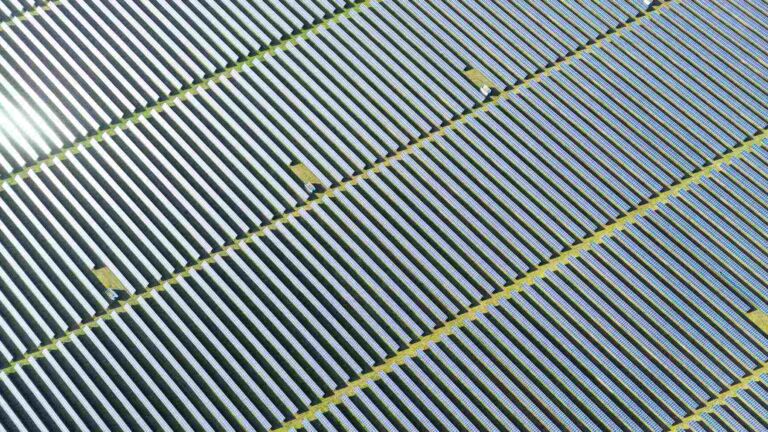
There are 3,276 panels on the property now, about 1.2 megawatts, enough for more than 300 homes. The racking is deliberately tall, high enough that a person can walk upright underneath and swing a tool, which most utility arrays are not.
Roughly five acres underneath are planted rather than mowed.
Spinach, sage, strawberries, sunflowers, beans and herbs have come out of those rows, more than 25,000 pounds of food since 2021. Researchers have come through for years counting yields, soil moisture and panel output.
Nobody had thought to ask the people in the rows
All of that research pointed at plants and electricity. The crew working between them had gone uncounted, which is what Talitha Neesham McTiernan, a human environment researcher at the University of Arizona, set out to change.
“In a lot of sustainability conversations, we’re thinking about resource use and not about farmworkers and their bodies,” she said when the results were presented in New Orleans last December.
She did two things at once. Instruments logged air temperature, wind speed, humidity and solar radiation in the rows and in the open field. Alongside that she interviewed the seven full time workers who harvest the site, because a data logger does not record what a body registers.
“By 9 a.m., in the summer, you’re just cooking,” she said. “Being able to take that direct heat load off makes such a difference.”
What seven people actually noticed
The reported benefits were smaller and more practical than a research abstract suggests. Drinking water left in the open goes hot enough to be useless within an hour, and one worker described it as being like drinking tea. Bottles tucked under a panel stay drinkable all morning.
Every worker mentioned being able to step sideways into shade without leaving the row and losing their place in the work.
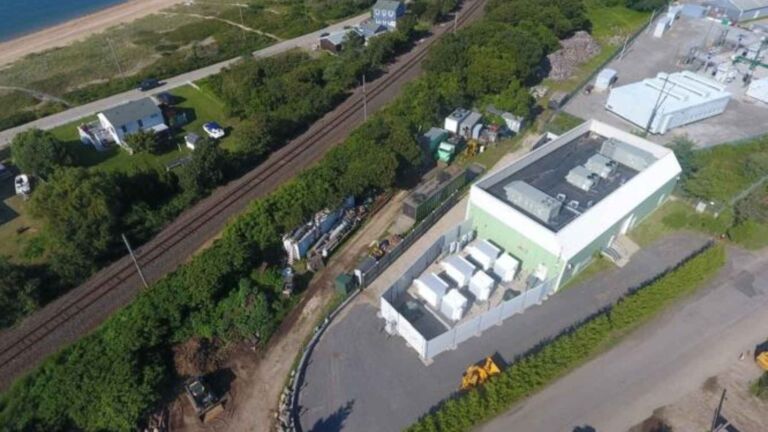
That pattern shows up wherever panels and animals share ground. Flocks brought in to trim vegetation have been recorded abandoning open pasture for the panel lines during a heatwave. Raising an array also changes what grows underneath, as the blueberry rows at a Massachusetts site have shown.
The animals worked it out first, and the grazing sheep in earlier trials were making the same calculation about direct heat load that the harvest crew makes every August morning.
The shade is not free and it is not everywhere
Panels take light away from plants, and that is the whole tension. In a cool cloudy region the shade costs a crop more yield than it saves in water, and the tall racking that makes a row workable is more expensive to build than a standard array bolted close to the ground.
Neesham McTiernan is direct about the limit. “It can’t be used everywhere,” she said, and she is extending the measurements into other climate zones.
What the Colorado readings settle is narrower and more useful than a verdict. Where this kind of array does get built, the shade underneath it is not a side effect to be tolerated. It is a measurable safety asset, and the full research summary is worth reading before anyone designs the next one.
For four years the panels at this farm were treated as a machine sitting above a science experiment. It turns out they were also a roof over somebody.
Read the whole thing?
Get the week's signal, not the noise
Our sharpest reporting on energy, climate and nature — free, once a week.